Quick answer
Clear aligners are removable and less visible, while fixed braces stay on the teeth throughout treatment and may suit some complex cases better. Neither suits everyone. The right option depends on your teeth, bite, lifestyle and commitment, and it is decided after an examination at Guildford Smiles Dental.
Introduction
Choosing between clear aligners and fixed braces is one of the most common questions people ask before straightening their teeth. Both can move teeth, and both involve planning, regular appointments and retainers afterwards. They differ in how they look, how they feel day to day, and which problems they are best placed to address. This guide sets the two side by side in plain terms, including where braces may be the better choice, so you can walk into a consultation in Guildford knowing what to ask.
What are clear aligners and fixed braces?
Clear aligners
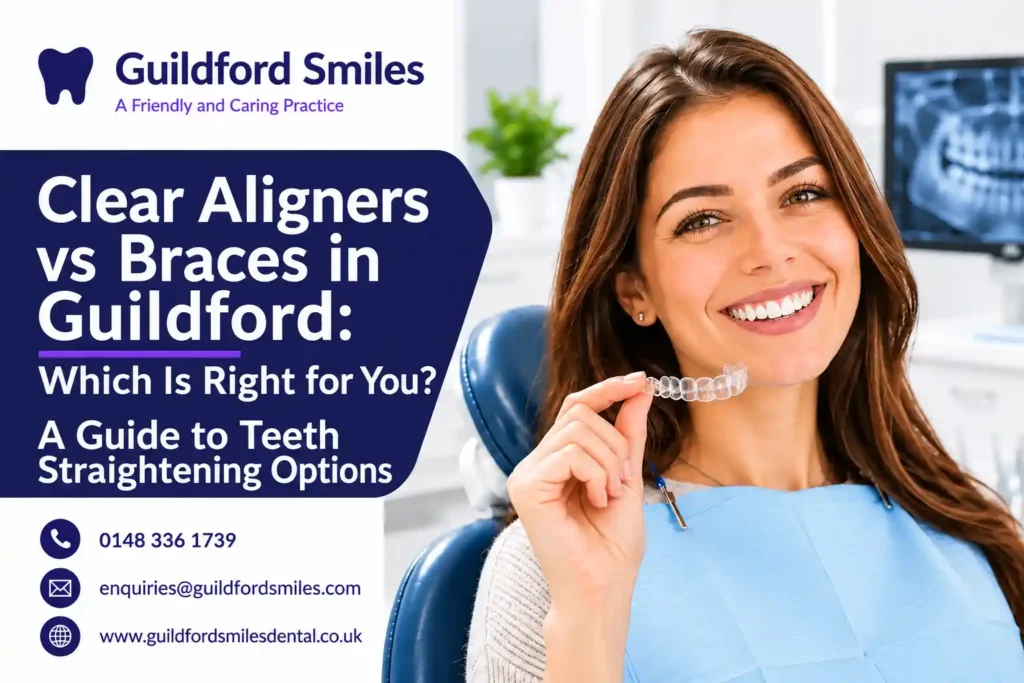
Clear aligners are a series of transparent, removable trays made to fit your teeth. Each tray moves the teeth by a small amount, and you change to the next tray at the interval your dentist sets. You take them out to eat, drink and clean your teeth, then put them back in. Invisalign is one well-known system, and Guildford Smiles Dental offers Invisalign alongside other clear aligners.
Fixed braces
Fixed braces consist of small brackets attached to the teeth and joined by a wire. The wire is adjusted at regular visits to guide the teeth into position. Because the brackets are fixed, they cannot be removed at home. Braces come in different styles, including metal and tooth-coloured versions.
Clear aligners vs fixed braces: a fair comparison
The table below summarises the main differences. It is a general guide only. How each point applies to you depends on your own teeth and bite.
| Factor | Clear aligners | Fixed braces |
| Visibility | Transparent trays, usually less noticeable, though small attachments may be used | Brackets and wire are visible, though some styles are less obvious than others |
| Removable | Yes, taken out for eating, drinking and cleaning | No, fixed for the whole of treatment |
| Hygiene | Easier to brush and floss as normal | Needs extra care around brackets and wires |
| Suitability | Often used for mild to moderate concerns, and some more complex ones | May suit a wider range of cases, including some complex bite problems |
| Discipline needed | High, because results depend on wearing trays as directed | Lower day to day, since the appliance stays in place |
| Appointments | Regular reviews, with trays supplied in sets | Regular adjustment visits |
| Limitations | Some tooth movements are harder to achieve | Dietary restrictions, and a higher chance of mouth irritation |
Neither column is a winner. Each has strengths, and the sections below explain what sits behind the table.
How the two treatments compare in everyday life
Appearance
Many adults and teens choose aligners because the trays are clear. They are not invisible, and some people notice a slight shine or a small lisp in the first days. Fixed braces are more visible, although tooth-coloured styles can be less obvious than metal ones. If appearance during treatment matters a lot to you, say so at your consultation.
Comfort
Both options can cause tenderness when teeth first start to move, particularly after a new tray or an adjustment. Braces can also rub on the cheeks and lips. Aligners usually have no sharp parts, but edges can occasionally irritate. Your dentist can advise on easing discomfort.
Eating and drinking
With aligners, you take them out to eat and drink anything other than plain water, then clean your teeth before putting them back. With fixed braces, you may need to avoid very hard, sticky or chewy foods that could damage the brackets or wire. Neither approach is effortless, they simply ask for different habits.
Cleaning and gum health
Brushing and flossing are usually simpler with aligners because nothing is stuck to the teeth. With braces, plaque can build up around brackets if cleaning is not thorough. Whichever you choose, keeping up with preventive care visits helps protect your gums and enamel while your teeth move.
Time and appointments
Treatment length depends on your case, not simply on the type of appliance. A short case may be straightforward with either option, and a complex one may take longer with both. Your dentist can give an estimate after an examination, though it is not a guarantee.
How clear aligner treatment works
For those leaning towards aligners, the process usually follows these steps.
- Consultation and examination. Your dentist checks your teeth, gums and bite and talks through your goals.
- Scans and records. Digital scans, X-rays or impressions help to plan treatment.
- Treatment plan. You are shown the proposed movements, the alternatives and the risks, and given a personal quote.
- Wearing the aligners. You wear each tray as directed and change to the next on schedule.
- Reviews. Your dentist monitors progress and adjusts the plan where needed.
- Retainers. Once movement is complete, retainers help to hold the teeth in place.
Who may be suitable for each option
Clear aligners may suit you if
You have healthy teeth and gums, a concern that aligners can reach, and the motivation to wear trays for most of the day. They are often considered for crowding, gaps and some bite concerns. For people who want to improve how their smile looks, aligners may form part of wider cosmetic dentistry planning.
Fixed braces may suit you if
Your bite problem is more complex, or you would find it hard to keep trays in for the hours needed. Fixed braces work continuously, since you cannot take them out. For certain tooth movements, an orthodontist or dentist may find braces more predictable. In these cases, braces may be the better recommendation, and a responsible clinician will say so.
When neither is the right first step
If you have untreated decay or gum disease, those need attention before any teeth are moved. Treatment should start only once your mouth is healthy enough.
Suitability is decided after an examination, so no article can tell you which route is right for your own teeth.
Benefits and limitations of each
Clear aligners
Possible benefits: discreet trays, removable for meals and cleaning, and digital planning that shows the intended movement.
Limitations: results rely on wearing trays as directed, some movements are harder to achieve, and attachments or small reshaping may be needed. Trays can be lost or damaged.
Fixed braces
Possible benefits: they work around the clock without needing daily decisions, and they can suit a broad range of cases.
Limitations: they are more visible, harder to clean around, may need food restrictions, and can irritate the mouth. Broken brackets or wires may need an unscheduled visit.
Risks common to both
Any tooth movement carries risks. These can include tenderness, gum irritation, enamel marks if cleaning is poor, and, in a small number of cases, effects on tooth roots. Teeth may also move back after treatment if retainers are not worn. Your dentist should explain these before you agree to start.
Retainers, aftercare and common mistakes
Retainers matter after both aligners and braces. Teeth have a natural tendency to drift, and retainers help hold them where they have been moved. Your dentist will advise whether you need removable retainers, fixed ones, or a combination, and how long to wear them .
Common mistakes include:
- Choosing an option because it looks easier, without checking whether it suits the problem.
- Wearing aligners for fewer hours than advised.
- Neglecting cleaning around braces or between trays.
- Skipping reviews or adjustment visits.
- Stopping retainer wear once the teeth look straight.
What about cost?
Costs differ between treatments and between cases, so a general comparison is unreliable. At Guildford Smiles Dental, clear aligners start from £1,850. This is a “from” price, and a personal quote is given after assessment. You can read more in our fee guide. Finance is available through Tabeo at 0% APR, subject to status, with terms applying. The practice does not provide credit itself.
Why choose Guildford Smiles Dental
Guildford Smiles Dental is a private practice at 8 Phoenix Court, Guildford, GU1 3EG. Our care covers general, preventive, children’s, emergency, restorative and cosmetic dentistry, along with orthodontics, implants, periodontics, prosthetics and specialist dentistry. You can browse our treatments to see the full range.
At your consultation we explain the options available to you, including those we would not recommend for your case, and set out the risks and what is asked of you before you decide. A personal quote follows assessment, and there is no pressure to start straight away .
Who we see locally
Patients visit us from Guildford and nearby areas including Woking, Burpham, Merrow, Worplesdon and Ripley.
What to expect at a consultation
At your first visit, your dentist will ask what you would like to improve, look at your teeth, gums and bite, and may suggest X-rays or scans. A new patient adult exam is £75, and a personal quote follows once your assessment is complete.
You will then discuss whether aligners, braces or another approach is more suitable, what the alternatives and risks are, and how much retainer wear and daily commitment each option involves. Bring any questions, including those about timing and finance.
Conclusion
Clear aligners and fixed braces can each be a good choice, and the better fit depends on your teeth, your bite and how you would manage day to day. A short conversation with a dentist is usually the quickest way to find out which route makes sense for you. To discuss your options, book a consultation with Guildford Smiles Dental.
You can call us on 0148 336 1739, email enquiries@guildfordsmiles.com or contact us through our website. We are at 8 Phoenix Court, Guildford, Surrey, GU1 3EG, open Monday to Friday, 8am to 6pm, and closed on Saturday, Sunday and bank holidays.
Frequently asked questions
Neither is better for everyone. Aligners are removable and less visible, while fixed braces may handle some complex cases more effectively. Your dentist will assess your teeth and bite and explain which approach may suit you.
Clear aligners are usually less noticeable because the trays are transparent, though small attachments may be used. Fixed braces are more visible, although tooth-coloured styles can be less obvious than metal. Individual preferences vary.
Aligners can address many common concerns, but not every case. Some complex bite problems or tooth movements may be better suited to fixed braces. Suitability is decided after an examination of your teeth, gums and bite.
Both can cause tenderness after tooth movement begins or a new tray or adjustment. Braces may also rub on cheeks and lips. Discomfort varies from person to person, and your dentist can suggest ways to ease it.
Often, yes, because aligners come out for brushing and flossing. Fixed braces need more careful cleaning around brackets and wires. Whichever you choose, good home care and regular hygiene visits help protect your gums and teeth.
In most cases, yes. Teeth can drift back after treatment, and retainers help hold them in place. Your dentist will advise on the type, how long to wear them, and how to look after them.
In some cases, yes, depending on age, teeth and how reliably the aligners would be worn. Your dentist will assess this at an examination and explain whether aligners or another approach may be more suitable.
Length depends on the case rather than the appliance. Simpler cases are usually shorter, and complex ones take longer. Your dentist can give an estimate after examining you, though it cannot be guaranteed.
At Guildford Smiles Dental, clear aligners start from £1,850 . A personal quote is given after assessment, and 0% APR finance via Tabeo may be available, subject to status.
You can book online through our patient portal, call 0148 336 1739 or email enquiries@guildfordsmiles.com. We are open Monday to Friday, 8am to 6pm, at 8 Phoenix Court, Guildford, GU1 3EG.