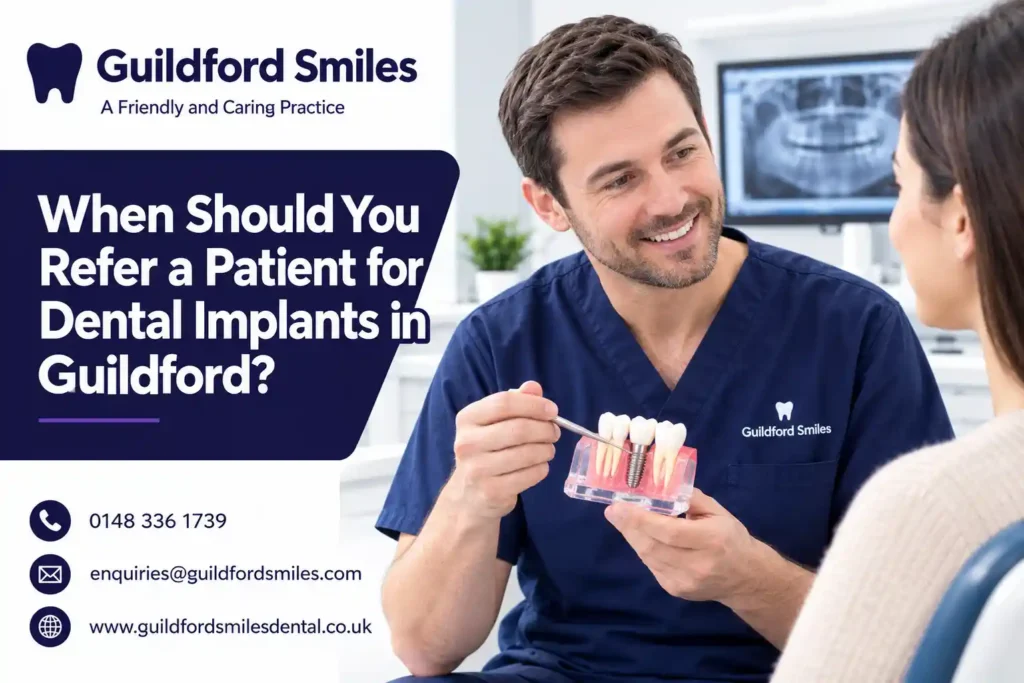
A patient is usually ready for a dental implant referral Guildford dentists can act on when they have one or more missing teeth, healthy gums, and enough bone to hold a fixture securely, or when it simply isn’t clear yet and an implant assessment is needed to find out. This article walks through the common scenarios where referring makes sense, what we look for during assessment, and what happens once a patient reaches us.
Not every case needs a specialist referral. But knowing which ones do, and when, helps you protect treatment outcomes and keep your patients’ confidence in your practice. Below, we’ve set out the situations that typically call for a referral, along with what to expect from the process at Guildford Smiles Dental.
Why General Dentists Refer for Implant Treatment
Most general dental practices are well equipped to manage routine restorative work. Implant placement, however, often benefits from additional training, imaging equipment, and surgical experience that not every practice has in-house.
Common reasons to refer include:
- The patient has a single missing tooth and wants a fixed, long-term replacement rather than a bridge or denture
- Several teeth are missing and the patient is considering multiple implants or a full-arch solution
- Bone volume looks reduced on an X-ray and a CBCT scan or bone graft may be needed
- The patient has been told they’re not suitable for implants elsewhere and wants a second opinion
- You’re simply unsure whether the case is straightforward or complex
If any of these apply, a referral for implant assessment Guildford patients can attend gives them a clear, unhurried consultation focused entirely on their options.
Single-Tooth Implant Cases
A single missing tooth, particularly at the front of the mouth, is one of the more common reasons dentists refer patients for implants. Patients are often keen to avoid grinding down neighbouring healthy teeth for a bridge, which makes a single implant an appealing option.
For these cases, we assess:
- The amount of bone at the site
- Gum health around the gap
- Bite alignment and how the new tooth will function
- The patient’s expectations around appearance, especially for front teeth
Once the assessment is complete, we discuss suitable options, which may include a dental implant, or in some cases a bridge via our crowns and bridges service if implants aren’t the right fit. Full details of the implant process itself are available on our dental implants page, which you’re welcome to share with patients ahead of their appointment.
Multiple Missing Teeth and Full-Arch Referrals
When a patient has several missing teeth, or is facing the loss of most or all of their teeth in an arch, the planning becomes more involved. This is where referral is particularly valuable, since outcomes depend heavily on accurate diagnosis and a well-sequenced treatment plan.
For patients missing multiple teeth, options we consider include:
- Several individual implants
- An implant-supported bridge
- A fixed full-arch solution such as All-on-4, where suitable
Full-arch cases usually need a CBCT scan to map bone structure accurately, along with a discussion about healing time and the number of visits involved. We always explain that your dentist can recommend the most suitable treatment only after a full clinical assessment, since no two patients’ bone density or gum condition are the same.
When a Patient Needs Specialist Assessment First
Some referrals aren’t ready for implant placement straight away. A patient might have gum disease that needs stabilising, a tooth that requires a complex extraction, or a level of bone loss that needs addressing before implants can even be considered.
In these situations, we may involve:
- Our periodontics team, to manage gum health before any implant work begins
- Surgical extractions, where a tooth needs careful, planned removal
- Bone grafting or a sinus lift, where the jaw needs building up first
- Broader input from our specialist dentistry team for more complex medical or dental histories
It’s worth referring these patients even if implants are months away. Early referral means the groundwork can start sooner, and the patient isn’t left waiting once they’re ready for the next stage.
What Happens After You Refer a Patient
Once a referral reaches us, the patient is invited in for a thorough consultation. This typically includes a discussion of their dental and medical history, a clinical examination, and imaging such as an X-ray or CBCT scan where needed.
Our team, introduced on our meet our team page, will talk the patient through:
- Whether implants are a realistic option for them
- Any preparatory treatment that might be needed first
- Roughly how long treatment is likely to take
- Costs, and finance options where relevant
We keep referring dentists updated throughout, and patients typically return to your practice for their ongoing routine care once implant treatment is complete.
Costs and Finance
Dental implants at our practice start from £2,500, with bone grafts or sinus lifts from £500 where needed, and full-arch All-on-4 treatment from £12,500. A full breakdown is available on our fee guide, and patients can also ask about our patient plan for ongoing preventive care.
For patients concerned about cost, we offer 0% APR finance through Tabeo, which spreads the cost of treatment over manageable monthly payments. It’s worth mentioning this option when discussing a referral, as it often changes a patient’s willingness to go ahead.
Supporting a Patient’s Wider Smile Goals
Implant referrals sometimes come alongside a patient’s broader interest in improving their smile. It helps to know what else we offer, so you can flag it where relevant.
Alongside implants, we provide:
- Cosmetic dentistry and full smile makeover planning
- Veneers and composite bonding for chipped or uneven teeth
- Tooth whitening to freshen the smile alongside restorative work
- Invisalign for patients who also want their bite or alignment improved
- Gum line correction where gum shape affects the overall look
- White fillings and prosthetics such as dentures, for patients needing a mix of solutions
Referring a patient for implants doesn’t mean handing over their whole treatment plan. We’re happy to work alongside you and simply focus on the implant element, then send the patient back to your care.
Referring Patients From Across the Area
We accept implant referrals from practices across Guildford and the surrounding area, including Woking and Shere, as well as Shalford and Godalming. Our Phoenix Court location is easy to reach for patients travelling in for an implant assessment appointment, with flexible weekday hours to fit around work and family commitments.
If your practice is based in one of these areas and you’re considering where to refer a patient for dental implants, we’re happy to talk through a case before you send the referral through, particularly if you’re unsure whether it needs specialist input.
Referring Children or Wider Family Members
Implant referrals are for adult patients, since implants aren’t suitable until jaw growth is complete. If a referral involves a younger family member needing general care in the meantime, our children’s dentistry and general dentist services, along with our preventive care programme, can support the rest of the family while the adult patient’s implant treatment progresses.
You can see the full range of services we offer on our treatments page, or visit our home page for an overview of the practice.
Frequently Asked Questions
You can send a referral by phone, email, or through our contact page, including relevant history and any recent X-rays. We’ll then arrange a consultation directly with the patient and keep you updated on the outcome.
Not always. Suitability depends on bone volume, gum health, and the patient’s general health. This is exactly why an implant assessment is useful, as it gives a clear answer rather than a guess.
Timelines vary depending on whether preparatory work like a bone graft is needed. Straightforward single-tooth cases can take a few months, while full-arch cases may take longer. Your dentist can confirm a realistic timeline after assessment.
Yes. Once implant treatment is complete, we’re glad to hand the patient’s ongoing routine care back to you, keeping you informed throughout.
If gum disease, bone loss, or another issue needs addressing first, we’ll explain this clearly and outline the steps needed before implants can be considered.
Yes, we offer 0% APR finance through Tabeo, which many patients find makes treatment more manageable.
In Summary
Referring a patient for dental implants doesn’t need to be complicated. Whether it’s a single missing tooth, several gaps, or a case where the right path isn’t obvious yet, sending the patient for an implant assessment gives them clarity and gives you confidence that they’re in experienced hands.
If you have a patient you think may benefit from an implant consultation, get in touch with our team through our contact page, or encourage them to book an appointment directly. We’re always happy to discuss a case before referral if you have questions. You can also ask patients to book an appointment themselves once you’ve made the referral, and our team will take it from there. For a full picture of pricing and what to expect, our fee guide and book an appointment page are both good starting points to share with your patient.